Engineer Program
Program upgrade skill di bidang engineering, dari dasar hingga mahir.
Spesial Program
Program khusus melalui platform mitra resmi dokter mekanik academy seperti Udemy, Prakerja, dan Kampus Merdeka.

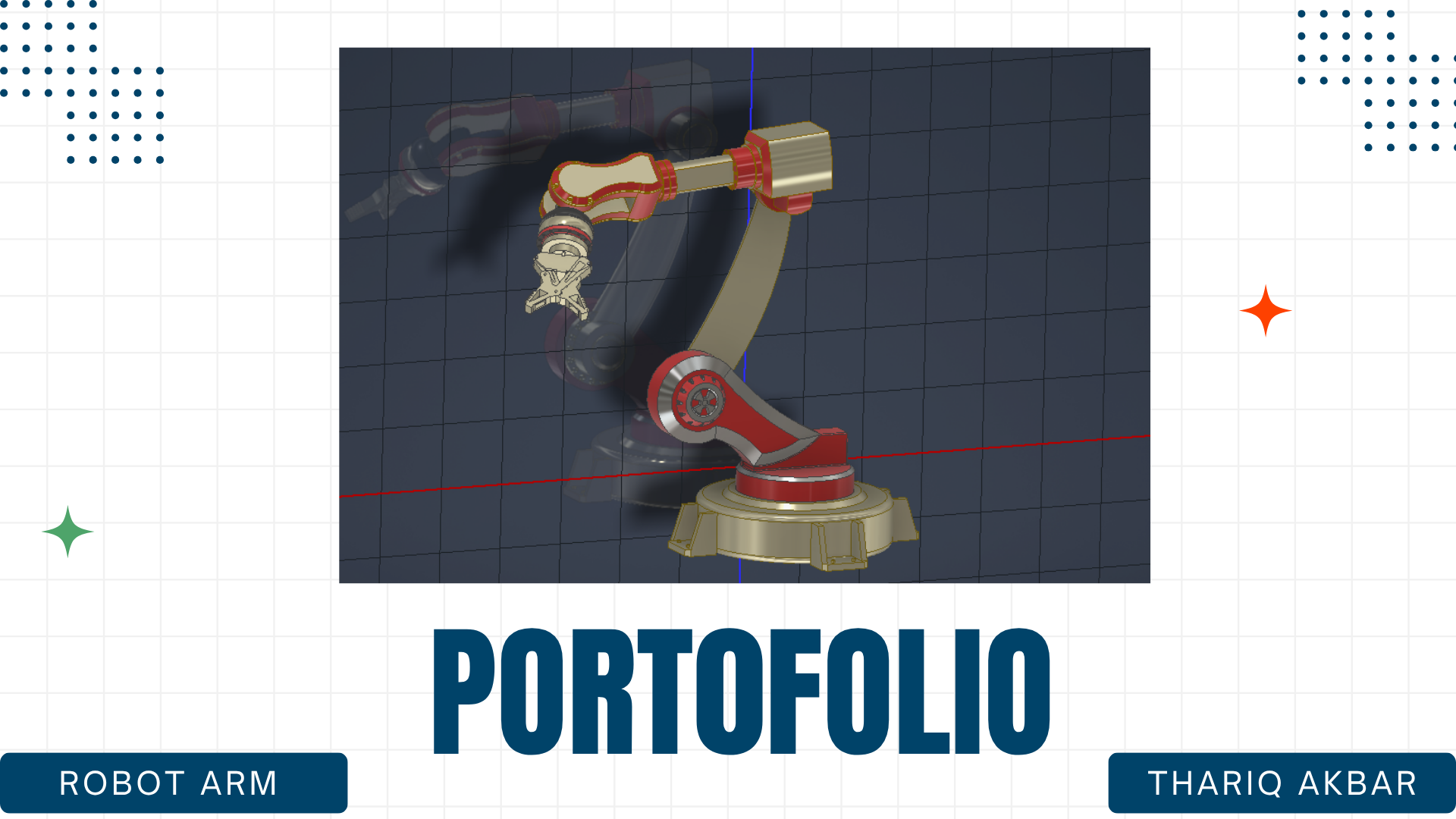
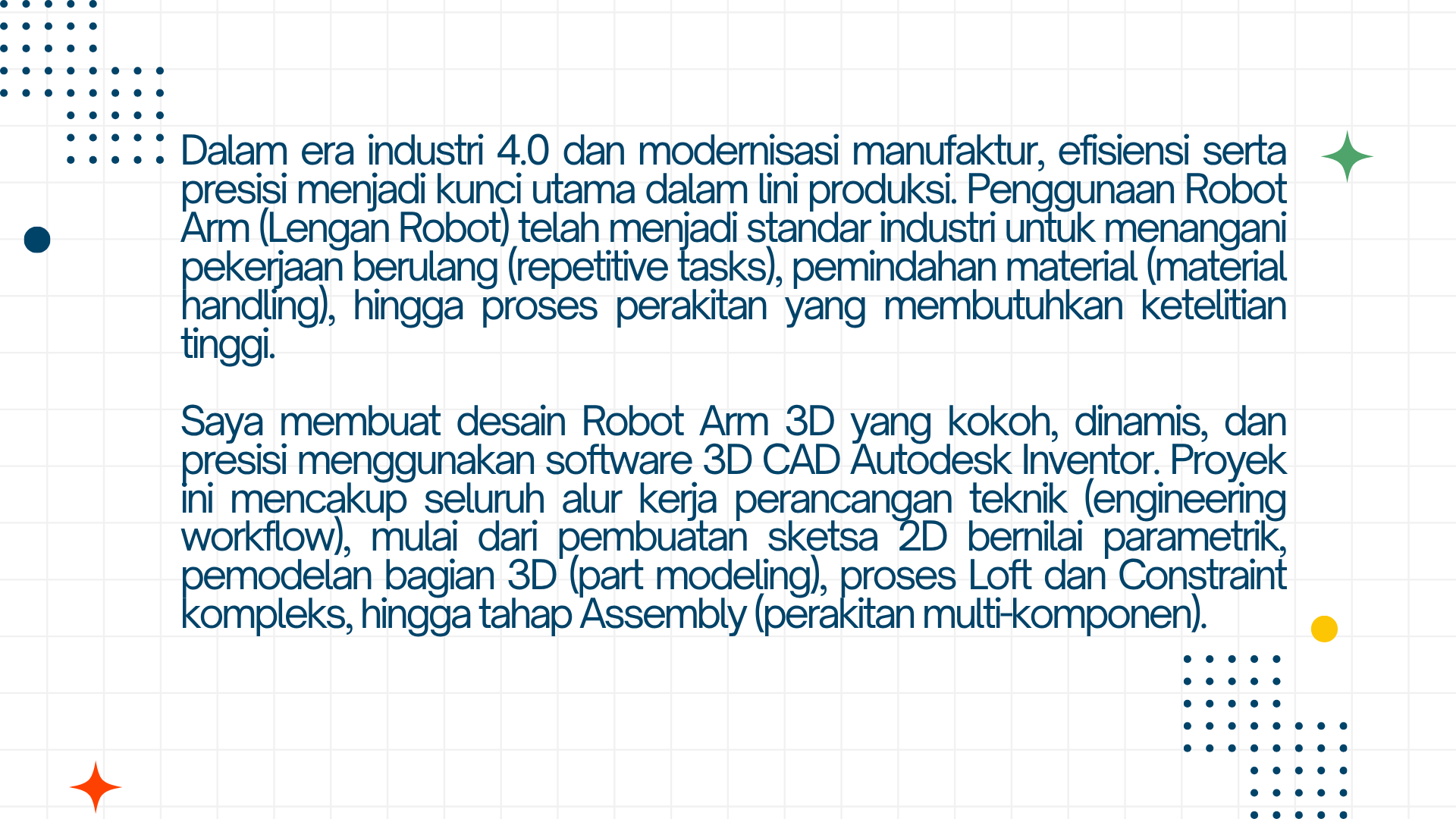
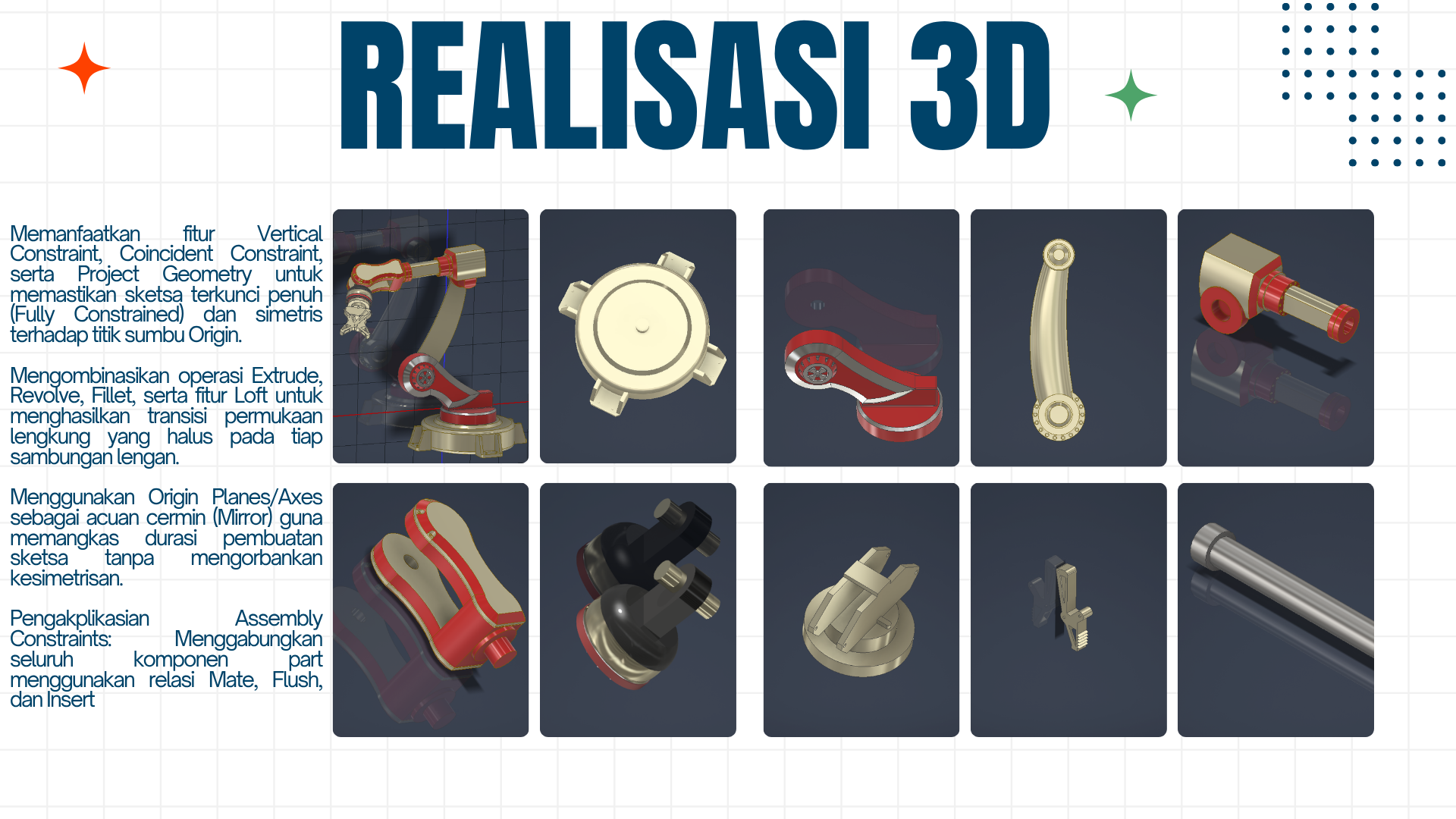
A robotic arm is a programmable mechanical device that mimics the movement of a human arm. It consists of multiple joints, links, and actuators that work together to perform precise movements for manufacturing, automation, robotics, pick-and-place operations, and industrial applications.
A robotic arm is a mechanical device designed to perform tasks similar to a human arm, often with programmable control and precision. It typically consists of multiple segments connected by joints, allowing movement in multiple directions (degrees of freedom). These arms are commonly used in industrial automation, medical procedures, and research. For example, in manufacturing, robotic arms assemble cars by welding parts or painting surfaces, while in surgery, they assist with precise movements during minimally invasive procedures. The core components include actuators (motors or hydraulics for movement), sensors (to detect position or force), a controller (to process commands), and an end-effector (a tool like a gripper or camera attached to the arm’s tip).
The functionality of a robotic arm relies on its control system and kinematics. The controller executes programmed instructions, translating high-level commands (e.g., “move to coordinates X,Y,Z”) into signals for the actuators. This involves solving kinematic equations—such as inverse kinematics, which calculates the required joint angles to position the end-effector at a target location. For instance, if a robotic arm needs to pick up an object, the controller determines how each joint should rotate or extend to align the gripper with the object. Sensors like encoders or torque sensors provide real-time feedback, enabling closed-loop control to adjust for errors, such as slippage or unexpected obstacles. Developers often program these systems using frameworks like ROS (Robot Operating System) or APIs provided by manufacturers, integrating logic for path planning and collision avoidance.
Practical applications highlight the versatility of robotic arms. In warehouses, arms equipped with vacuum grippers sort packages by identifying barcodes and placing items on conveyor belts. In laboratories, they automate repetitive tasks like pipetting liquids into test tubes. Custom end-effectors expand their utility: a 3D-printing nozzle can turn the arm into an additive manufacturing tool, while a camera module enables visual inspection of products. Underlying these use cases is the arm’s ability to combine precision, repeatability, and adaptability. For developers, integrating a robotic arm often involves writing scripts to define motion trajectories, calibrating sensor inputs, and testing safety protocols to ensure reliable operation in dynamic environments.
1 Orang Menyukai Karya Ini