Engineer Program
Program upgrade skill di bidang engineering, dari dasar hingga mahir.
Spesial Program
Program khusus melalui platform mitra resmi dokter mekanik academy seperti Udemy, Prakerja, dan Kampus Merdeka.
IoT technology has impacted several industries, including agriculture. It is now feasible to create straightforward, inexpensive plant monitoring systems that can assist farmers in keeping an eye on their agricultural systems thanks to the wide variety of various sensors and actuators that are becoming available on the market, in conjunction with microcontrollers and Internet of Things modules. This work intends to develop an IoT-based agricultural monitoring implementation system in order to improve the growth of chili plants. The system is created based on the previous work by being carried out in five planters with chili measuring four factors, including light, temperature, humidity, and soil moisture sensors, and connecting them to ThingSpeak. Experiments have shown that the system is capable of measuring the relevant parameters and transmitting the measurement data to a mobile device, enabling farmers to remotely monitor their crops.
One common food product that experiences fluctuations in its stock and market price is the chili pepper. Demand and price fluctuations for chili peppers have been a persistent issue. On the one hand, there is still an enormous demand for chili in Indonesian society. However, in certain circumstances, the market price of chilies changes. Many factors influence the price of chilies, from extreme weather which affects the quality of the chilies or decreases market commodity, the impact of festival consumption which frequently calls for chili peppers as the primary ingredient, chili growers' contracts with the business, to the chili supply chain itself are a few of the causes. Often, these changes are most noticeable during harvest, when prices fall dramatically, causing farmers to start losing profit because they cannot meet their operational costs. As a result, a solution that may assist farmers in reducing this problem by deploying technology-based solutions that are simple for farmers to implement, low in cost, and allow farmers to monitor their agricultural crops from anywhere is essential.
This work aims to implement IoT technology that will be used to monitor the environment around chili plants in a greenhouse, including average sunlight, temperature, and humidity. The measurement data from those mentioned sensors is then monitored via ThingView, a mobile-accessible component of ThingSpeak. Being placed in a field, smart sensors collect essential data, including the humidity, temperature, and other related data. All the data produced by the sensors is then forwarded to the data acquisition part. Data acquisition will retrieve, collect, and prepare data measurement and analyze various data provided by sensors and represent it as the desired data for data monitoring purposes. By using this method, farmers in urban settings may be able to do specified yet simple monitoring easily and economically using their smart devices (such as their cell phones and tablets).
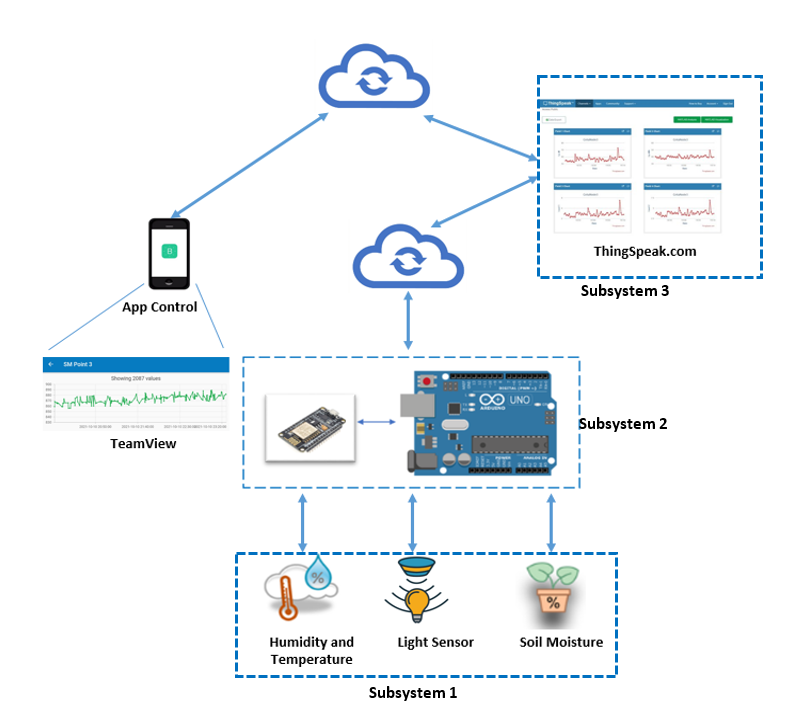
Fig. 1 shows the proposed study's overall system design. There are three main subsystems in the system. Sensors attached to the greenhouse area are part of subsystem 1. The system uses light intensity sensors, soil moisture sensors, temperature sensors, and humidity sensors to gather and measure various types of data. This subsystem gathers the necessary information based on the present environment, including the light intensity, local temperature and humidity, and soil humidity.

Fig.1. Proposed System Design
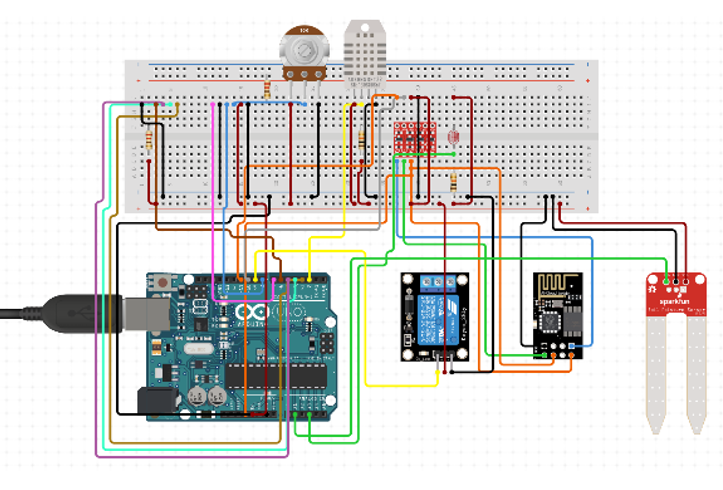
Data transfer and ESP8266 are included in subsystem 2. The Arduino UNO microcontroller, which serves as a main processor and manages the data gathered from the sensor through input ports, will be in communication with the sensor. Through a Wi-Fi connection, the data will be directly shown to the cloud that the ESP8266 module supports. Subsystem 3 also includes a web-based application called ThingSpeak for data collection and monitoring. This subsystem's job is to keep an eye on various important greenhouse characteristics, including the temperature, humidity, and conditions for plant growth. To facilitate understanding, all gathered data will be uploaded to the ThingSpeak platform and shown visually as tables, charts, or graphs. The hardware design of this system as described in Fig.2

Fig 2. The Hardware Design of the System Proposed
The main focus areas observed are the environmental light, temperature, and humidity parameters and the soil moisture in each pot in the two greenhouse areas. The overall components used in this work are as shown in Fig. 3. The system will replace the classic farming method, where farmers can find out the status of their fields remotely from anywhere through the ThingView application.

Fig.3 IoT System for Optimization Plant Growth System Integrated to ThingSpeak
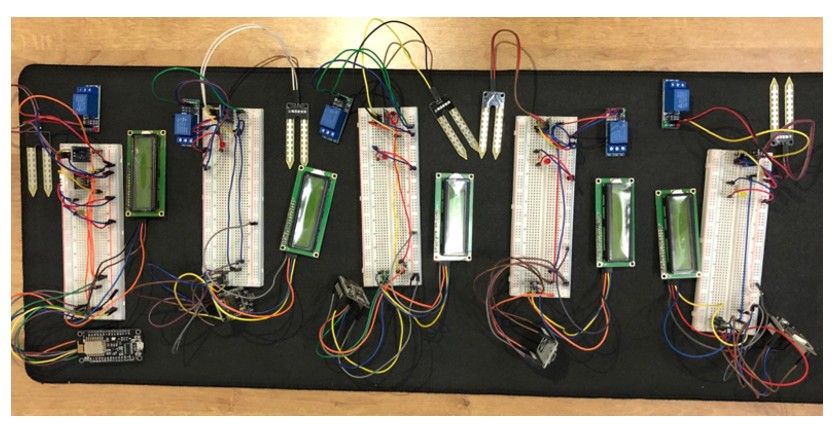
A soil moisture sensor connected to ESP8266 was dipped in the soil of each pot to get the value measurement and send the measurement value to the ThingSpeak channel. In this case, 5 pots have been utilized, which are shown in a small greenhouse to get the value measurement as described in Fig.4. Furthermore, the measurement value will be sent to the ThingSpeak channel, as seen in Fig.5.

Fig.4 IoT System for Optimization Plant Growth System Integrated to ThingSpeak Implementation Result

Fig.5 Monitoring Result of IoT System for Optimization Plant Growth System
0 Orang Menyukai Karya Ini